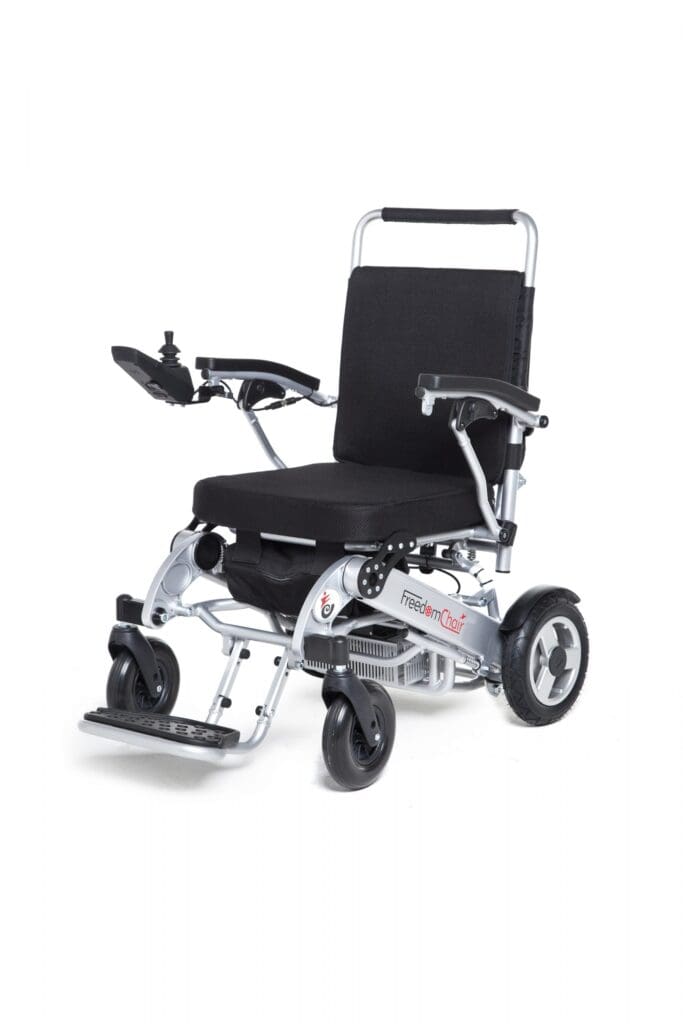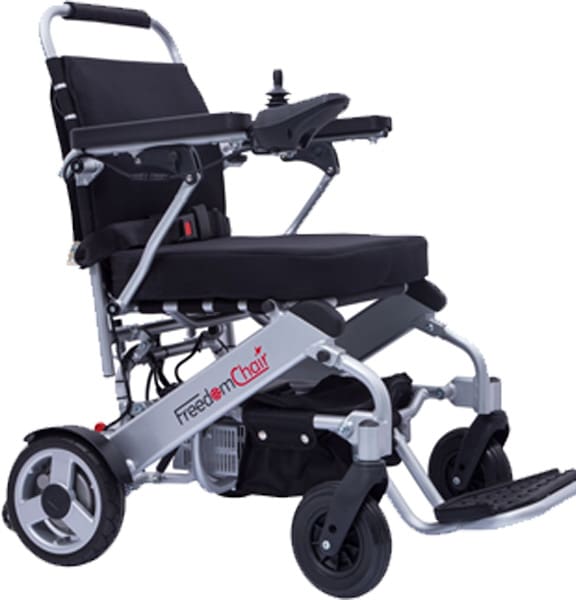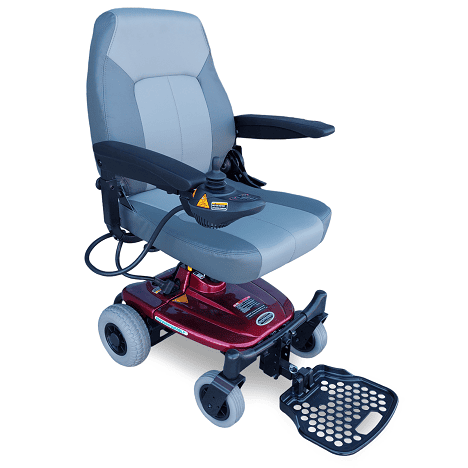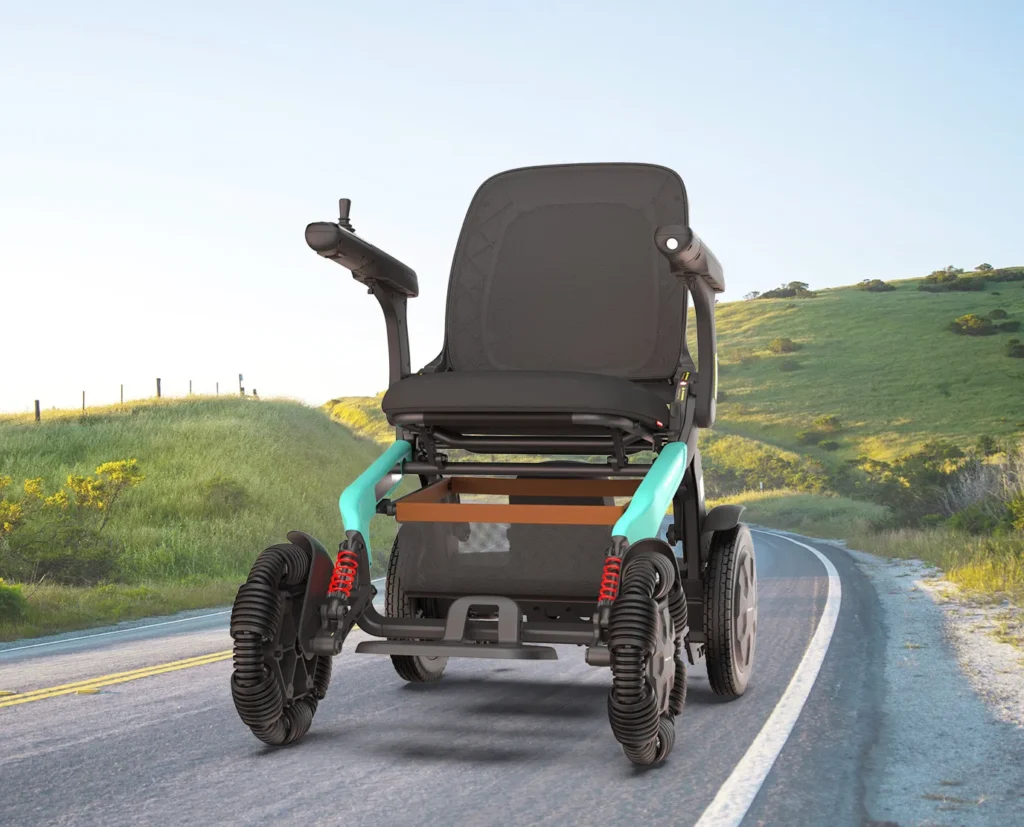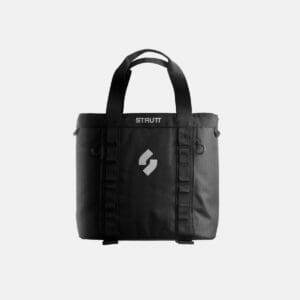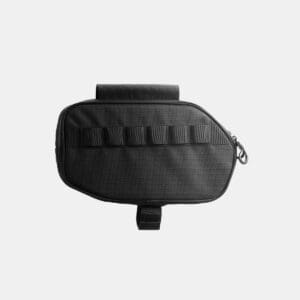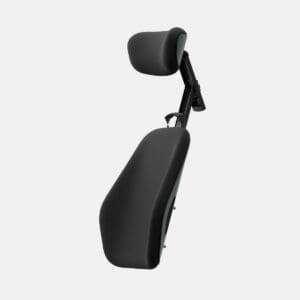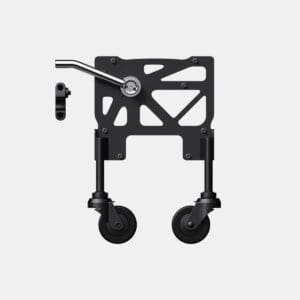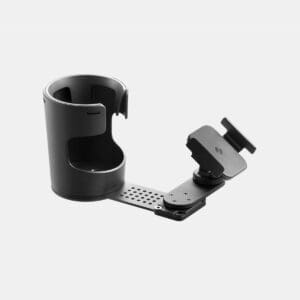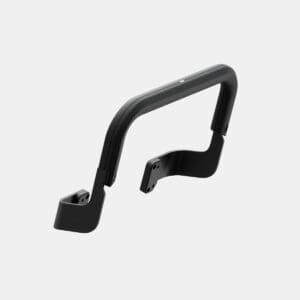
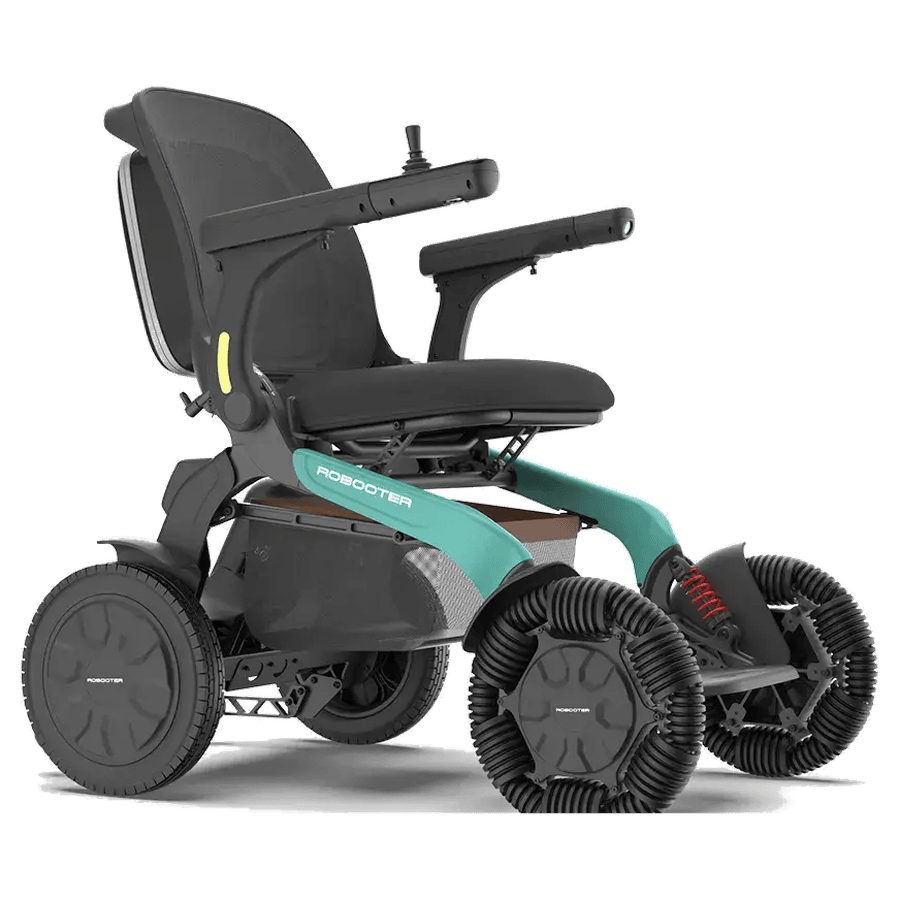
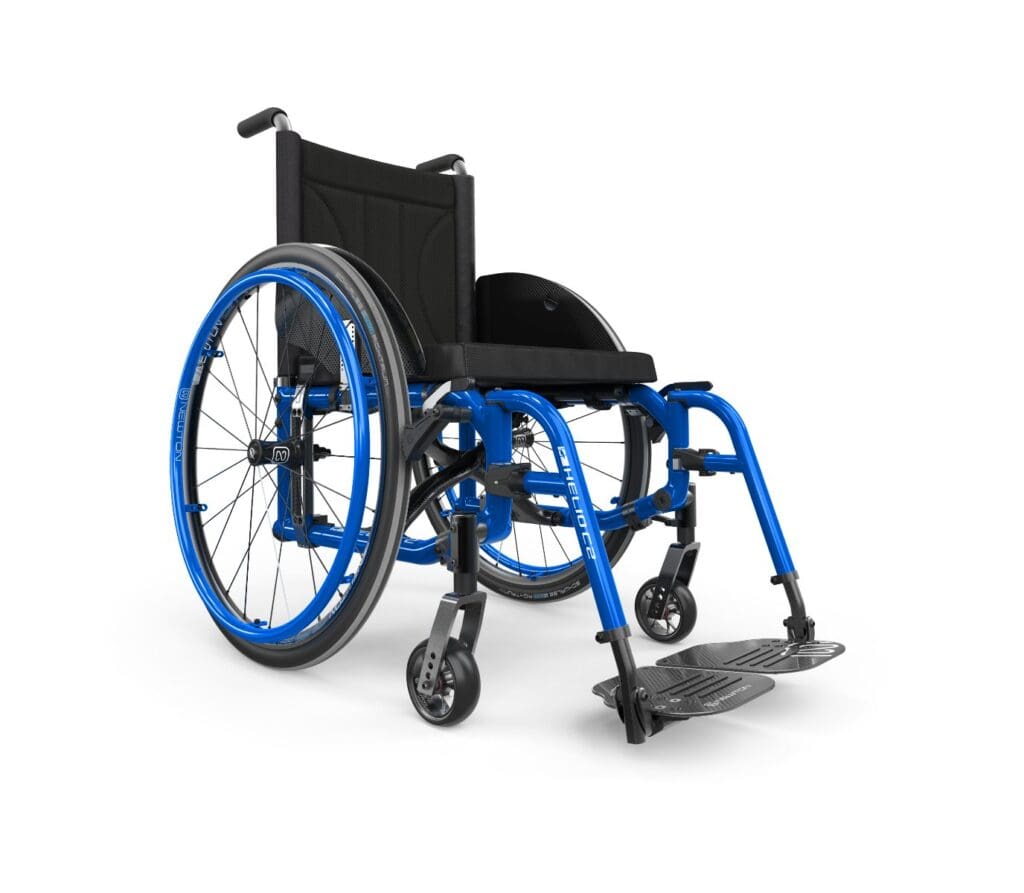
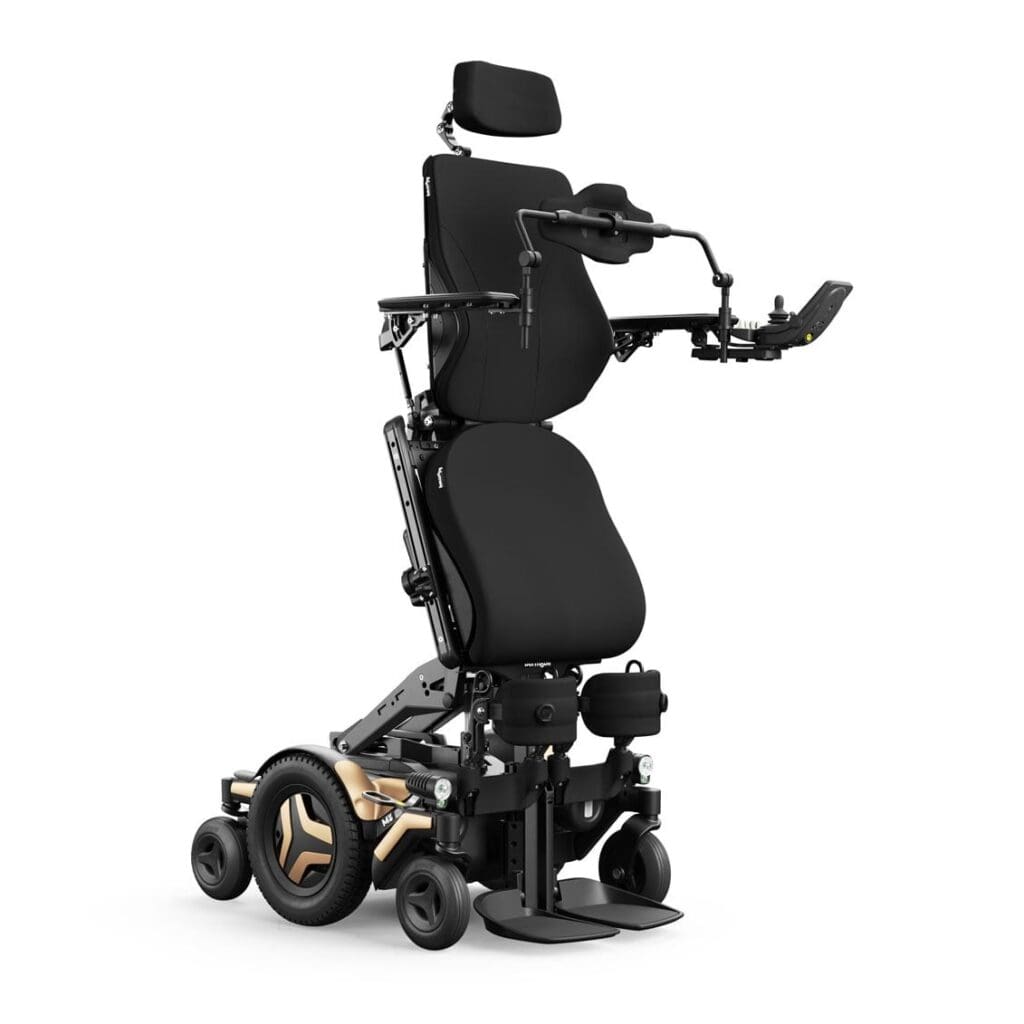
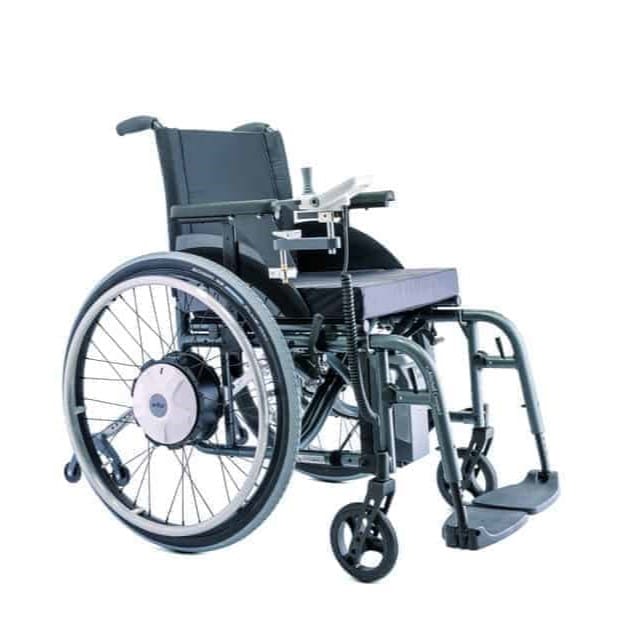
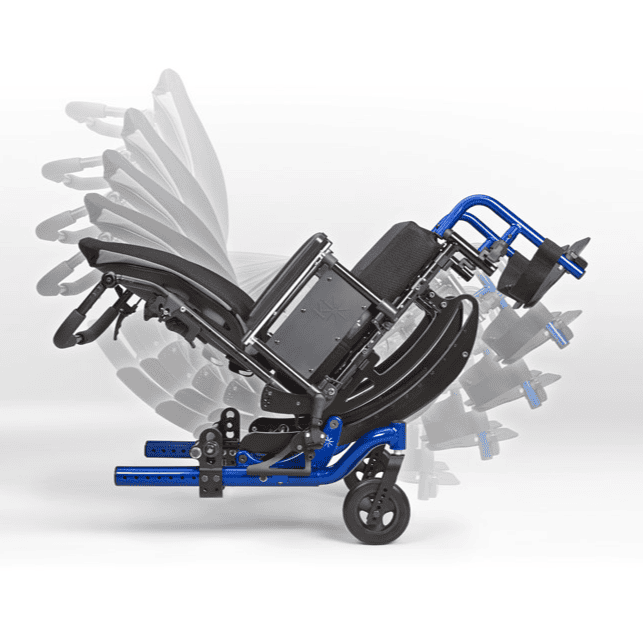
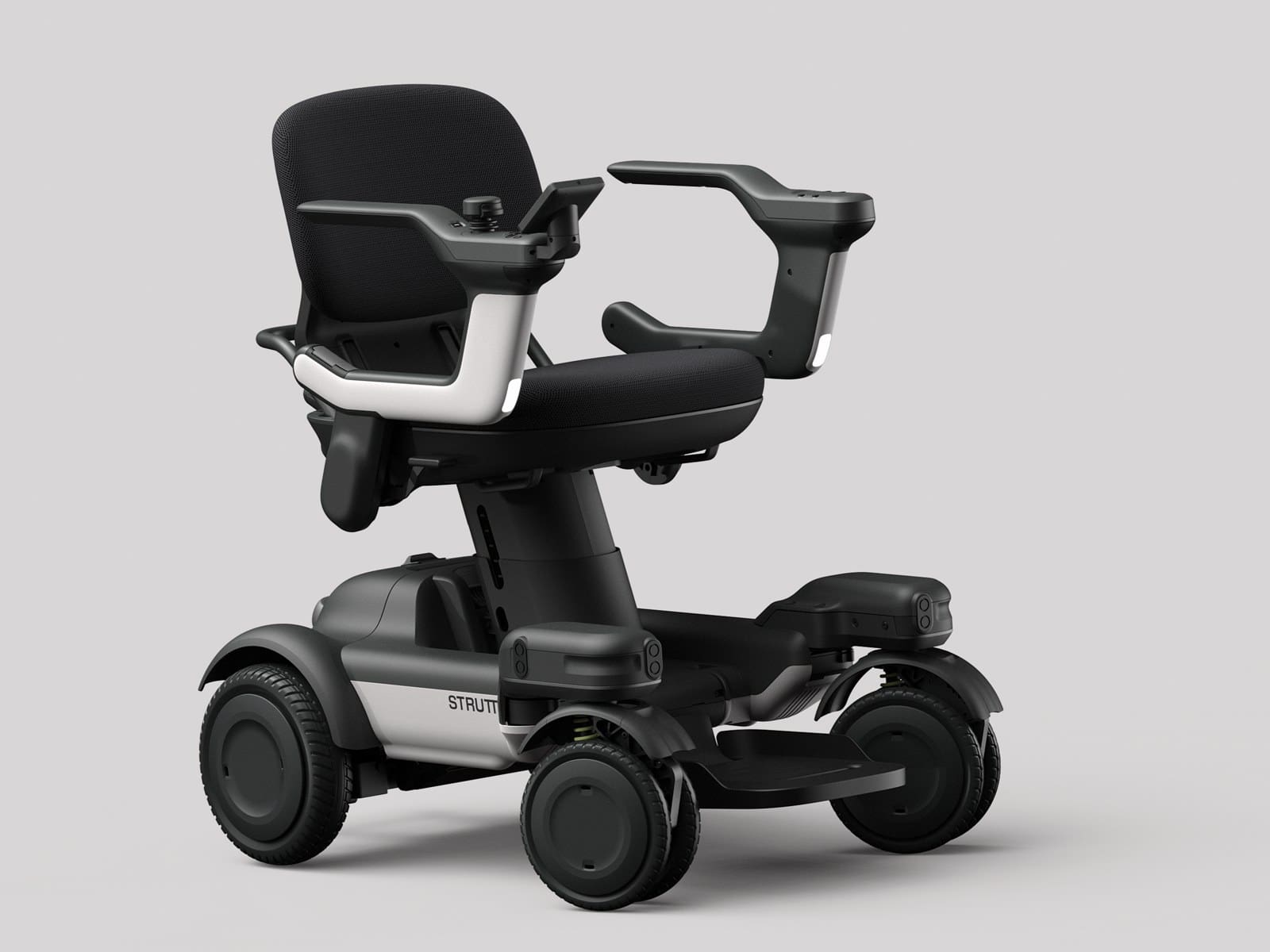
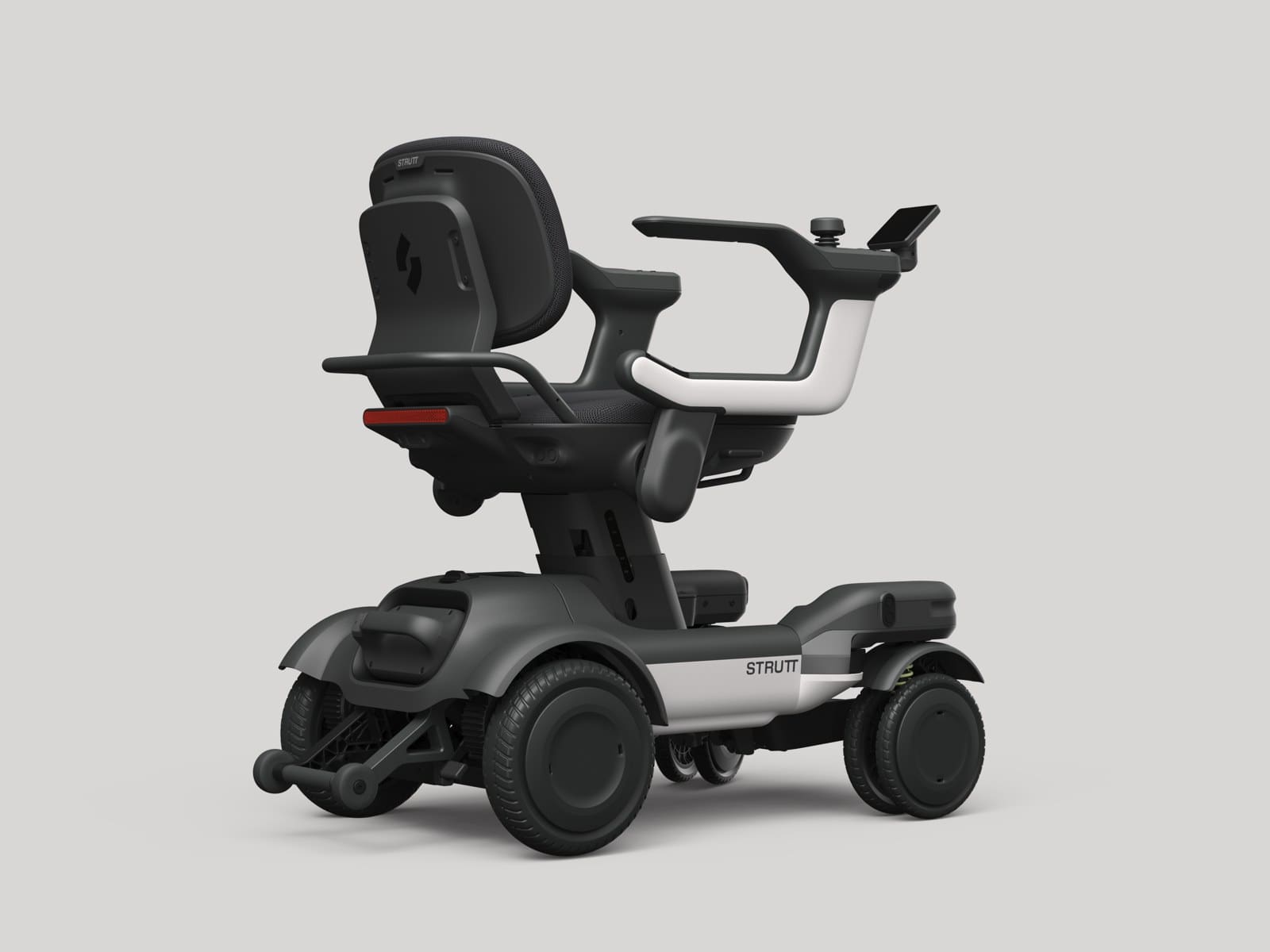
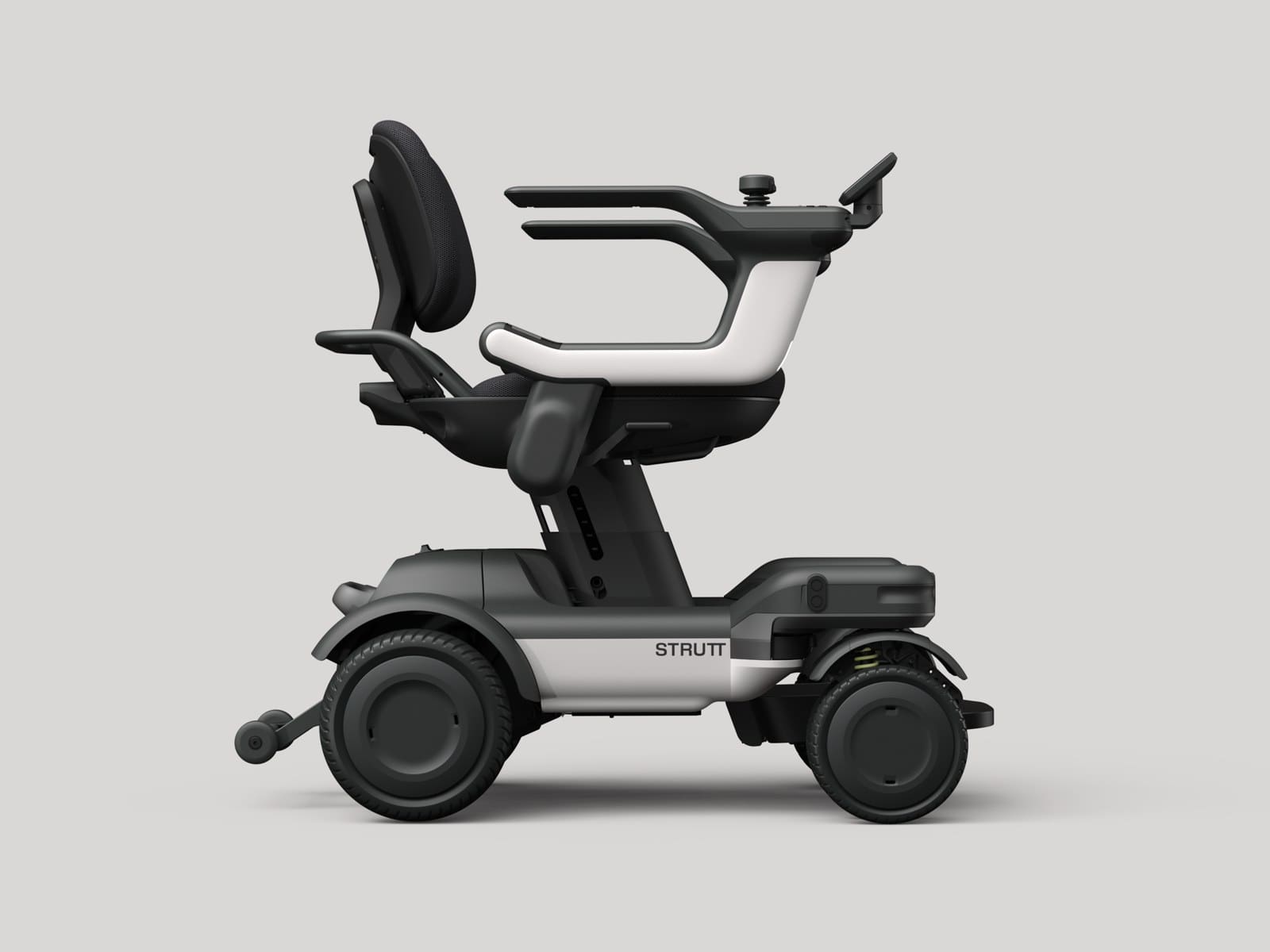
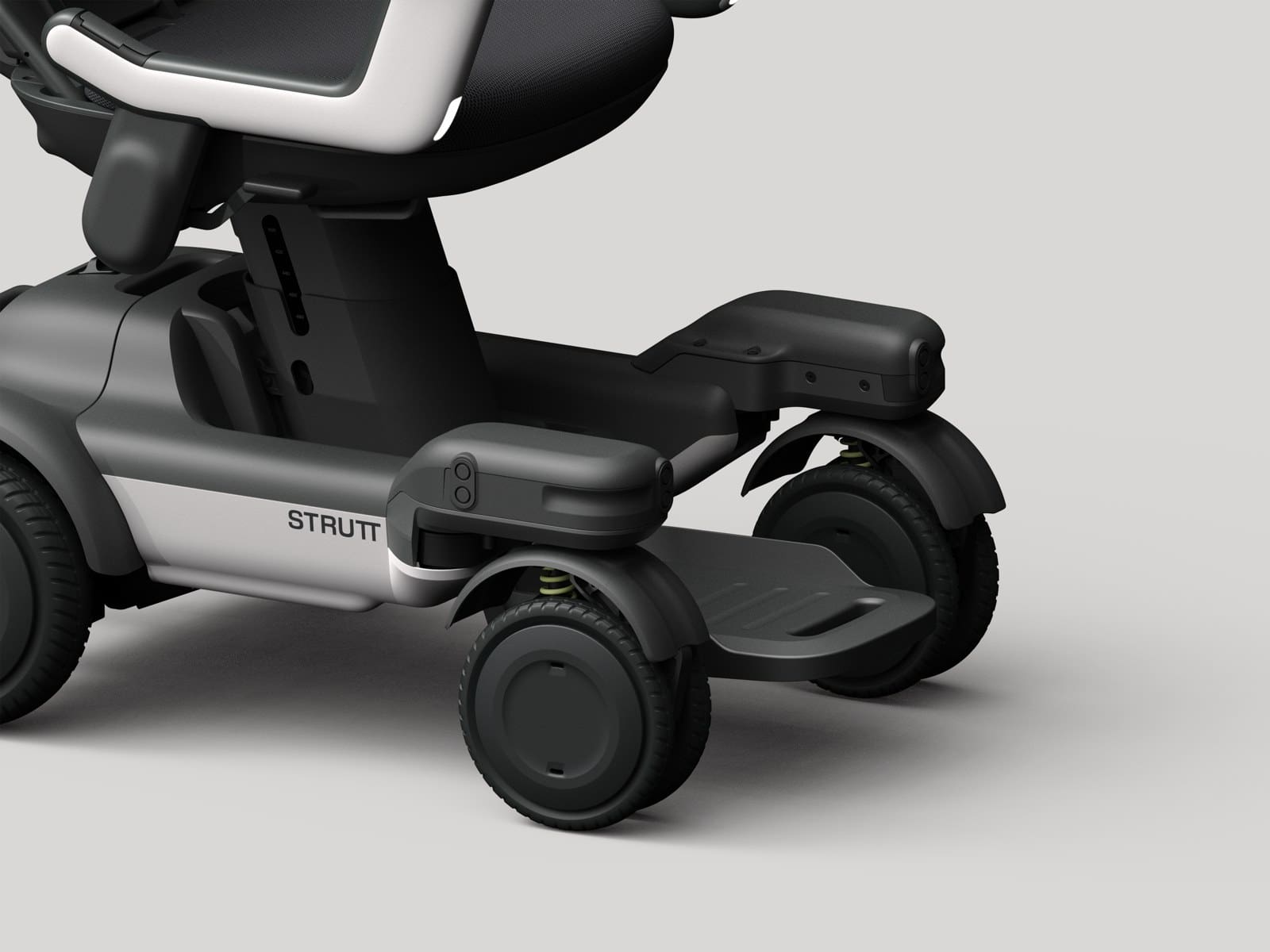
The Strutt ev¹e is the same chassis, the same four motor Quad-Drive and the same seating as the ev¹c, without the evSense sensor system. Everything that makes the chair drive the way it does is still there. What comes out is the assisted driving layer, and with it a large part of the price.
For a driver who is confident on a joystick and does not need obstacle assistance, the ev¹e is the sensible half of the range.
Quad-Drive: why it handles differently
Two front motors steer, two rear motors drive, and all four wheels sit on independent suspension. Torque moves between wheels in real time, so traction holds on gravel, grass and wet ground, and the front wheels point where you are going instead of scrubbing round. Turning radius is 780 mm, tight enough for a domestic hallway.
Kerb height 50 mm, gap crossing 120 mm, climbing slope around 13 degrees at full 160 kg load, ground clearance 80 mm.
What you keep, and what you give up
Kept on the ev¹e
Quad-Drive, four wheel independent suspension, active steering, the 4 inch touchscreen, the rear view camera, six ultrasonic sensors, headlight, freewheel mode, USB-C output, the Strutt app, and the same battery, charger and seating range.
Only on the ev¹c
The evSense sensor array, Co-Pilot and Co-Pilot+ obstacle assistance, Pathfinder and Waypoints navigation, the voice assistant, and over the air updates that add new features rather than only improvements.
Driving performance is identical on paper: same speed, same range, same 160 kg capacity, same turning radius, same dimensions, same IPX5 rating.
Setting it up for the person
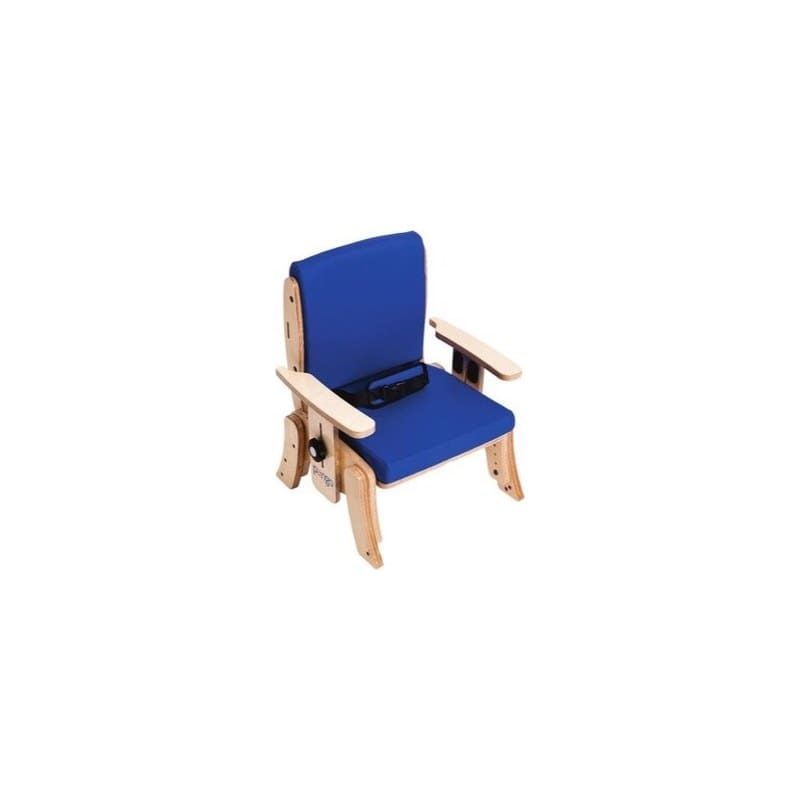
Adjusted on the chair with the supplied tools. There are no powered seat functions.
- Seat width, three settings: 442, 480 and 518 mm.
- Seat height, six settings from 400 to 500 mm in 20 mm steps, measured by Strutt from the footplate rather than the floor. Confirm seat to floor against the transfer surfaces in the person’s home.
- Backrest height, four settings: 350, 375, 400 and 425 mm. Backrest angle, three settings: 13, 16 and 19 degrees.
- Armrest height, three settings: 220, 240 and 260 mm. Both armrests flip up and rotate back for a side transfer.
- The screen and joystick module moves to either armrest for a left or right hand driver.
- Seat angle fixed at 5 degrees. Positioning belt standard.
Battery, charging and range
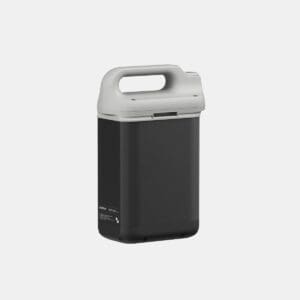
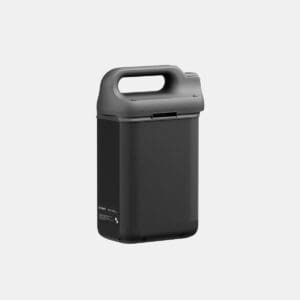
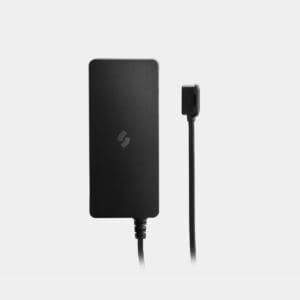
The same 640 Wh lithium iron phosphate battery, up to 32 km on a charge, 80 per cent in about two hours and full in about four, rated to roughly 3,200 cycles. Because there is no evSense drawing power, the ev¹e quotes a single range figure rather than two. The battery lifts out for charging away from the chair.
Travelling with it
Five modules including the battery, heaviest about 19.8 kg. The Flight-safe Battery and Freewheel Kit both fit the ev¹e, so the same travel setup applies. Airline acceptance varies by carrier.
What the ev¹e does not do
- No powered tilt, no recline, no lateral trunk supports and no head support. The Extended Backrest accessory adds height only.
- No alternative access. Joystick only, with no eye gaze, chin or head control.
- No obstacle detection or braking assistance. If the driver needs that, specify the ev¹c.
- Not crash tested as a vehicle seat, so the user transfers to a certified seat for travel.
- Deep sand and mud are outside the intended envelope, and the manual prohibits use on public roads.
Common questions
Can an ev¹e be upgraded to an ev¹c later?
No. evSense is a hardware fit, not a software unlock, so the decision is made at order. If obstacle assistance is likely to be needed within the life of the chair, specify the ev¹c from the start.
Does the ev¹e still have a camera?
Yes, a rear view camera shown on the touchscreen, plus six ultrasonic sensors. What it does not have is the LiDAR and time of flight array that drives the assisted modes.
What weight range does it suit?
25 kg to 160 kg including the driver and anything being carried.
Can a carer push it?
Yes. Manual brake release levers on both sides put it in freewheel, and the Smart Push Handle accessory adds motor assist.
Is it certified for NDIS or assistive technology funding?
Talk to us before you write it into a report. We will give you the current Australian regulatory and standards position in writing rather than a general answer here.